
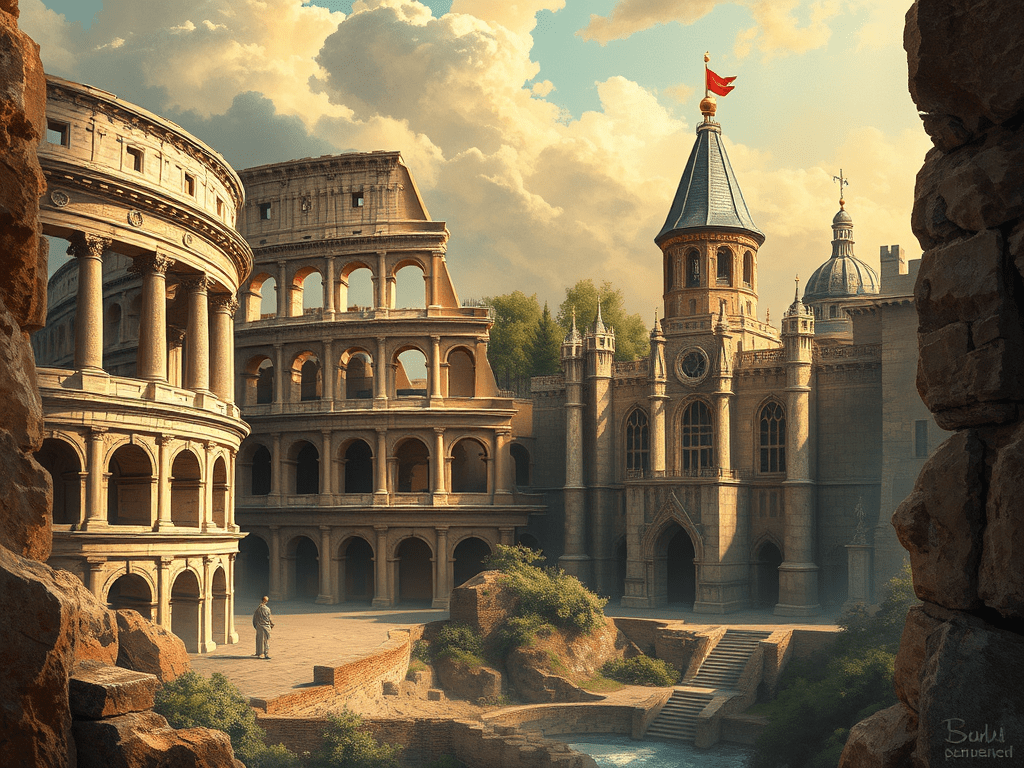
I’m now a bit of a history nerd. I admit it. It is not my fault. COVID and my friend James Coulter are to blame.
James started it, he got me interested in The History of English podcast with a lunchtime anecdote about the discovery of the common Indo-European language that underpins many Western and many Asian languages. How a British tax official needed Indian texts translated as part of the administration of the Raj, and how the man who was called in to do the translation was astounded by the similarity of the ancient texts in India and other ancient texts in Europe, which led to the modern theory of language development and the identification of a common Indo-European culture from which the English language rose.
I love those kind of things.
So I started listening to that podcast and listened to many episodes, but eventually got bogged down in the esoteric aspects of pronunciation and language technicalities. What really interested me was the historical narrative that accompanied the series.
When the first of the lockdowns started in 2020 our family started doing the wonderful online Jays Pub Quiz, and I was looking to expand my general and historical knowledge. I had stopped listening to The History of English but one day on my bike ride I did for my exercise during lockdown, I thought, “I wonder if there is a podcast that can tell me the order of the Roman Emperors?”
I had heard of many of the emperors but knew nothing of the order of them or their back stories. So a quick search on Spotify and lo and behold, there was a podcast entitled, “The History of Rome”. “That should do the trick”, I thought. Little was I to know the deep, deep rabbit hole I was about to enter.
I started listening to The History of Rome which was presented by an American called Mike Duncan. He was informed, witty, easy to listen to and I was immediately hooked. He was not a professional historian, more of a lay enthusiast, and it made the whole podcast so much more accessible to a listener like me, who knew nothing really of history and especially Roman history.
One hundred and seventy-nine episodes later, I was done. Mythical beginnings of Rome all the way through to AD 476 and the fall of the Western Roman Empire. What next now? I wondered. Mike had another podcast called Revolutions, which for some reason did not appeal to me at the time, so I thought about looking at the Romans through the eyes of their arch-enemies, the Persians and so found another podcast called The History of Persia.
I couldn’t quite get on with this one. I’m sure it appeals to some, the guy was an academic and knows his stuff inside out, however the series, for me, did not flow like Mike’s had, and had none of the wit or the easy listening quality. I did pick up on one thing though. At the start of one of the episodes, it was stated that to get the opposite perspective of history from the Persians, one might like to listen to The History of Rome (already did that) and The History of Byzantium.
What? Wait? History of Byzantium? What was that?
The only time I had heard of Byzantium was when I had played the computer game Age of Empires II. I didn’t even know it was a thing! What was this Empire of Byzantium?
So I listened to the first episode of The History of Byzantium and I understood. The Empire of Byzantium or the Byzantine Empire IS the Roman Empire and is just a label given to it by later scholars to differentiate it from the classical Roman Empire of antiquity. Byzantium is the original Greek name of the city that the Emperor Constantine founded on the Bosporus, the city known as Constantinople and is now modern day Istanbul. So the Byzantine Empire is what is also known as the Eastern Roman Empire and it continued to function as a coherent state all the way through to 1453, at which point the city was captured by the Ottomans and the last emperor of the Romans, Constantine XI was killed defending his city.
The History of Byzantium podcast is still going and it’s creator Robin Pierson and Englishman has done an amazing job of keeping the history going. It’s currently in the 1300s at the moment and the empire is very much on it’s last legs, but the history of the Byzantine Empire is just such an incredible story, you would think it is a work of fiction, but it is all factual, though no doubt due to the age of the sources and their natural bias, the stories are probably somewhat embellished. Robin has been of enormous help to me in providing bundles of research material to aid me in my background research for my historical novels, more of that later perhaps. I am a patreon member of The History of Byzantium as I wish to support Robin in his work.
Robin has taken a few breaks in his podcasting for various reasons and during one of those breaks I needed my history fix, and so I thought, well I’m an Englishman, I should know more of my own country’s history and so I found and started listening to The History of England. This is still going as well and is narrated by the wonderful, knowledgeable and erudite David Crowther, whose turn of phrase and humour makes the podcast a delight to listen to. His offshoot “shedcasts” are also a joy to listen to covering biographies of figures from english history, place names, constitutional history and naval history for example. I am a fully paid up subscriber of The History of England.
My final history podcast of which I am a regular listener and fully paid up Friend of the Show, is The Rest is History . This is an internationally renowned podcast that is hugely successful and features historians Tom Holland and Dominic Sandbrook. They make a fantastic pairing, bringing incredible moving stories, myth-busting narratives as well as humour and wit to such world shattering subjects as The Battle of Trafalgar, The Reformation, The Rise of the Nazis, The Fall of the Aztecs as well as more niche topics like The Worst Parties in History, The Real DaVinci Code, Famous Monkeys, Catherine of Sienna and The Costa Rican Civil War.
So now I am a history nerd. I’m a lost cause. Engage me in conversation and I am always looking to bring in some historical metaphor or anecdote. I’m sorry, just can’t help it …
Oh and I did go back and listen to Mike Duncan’s Revolutions podcast, it was brilliant of course, particularly informative and incredible was the Haitian Revolution, as well as the big ones like the French and Russian. Well worth the listen, not so sure about his latest offering though, a sort of Sci-Fi future history…
Cheers



 Dave Mc's Blog
Leave a comment