
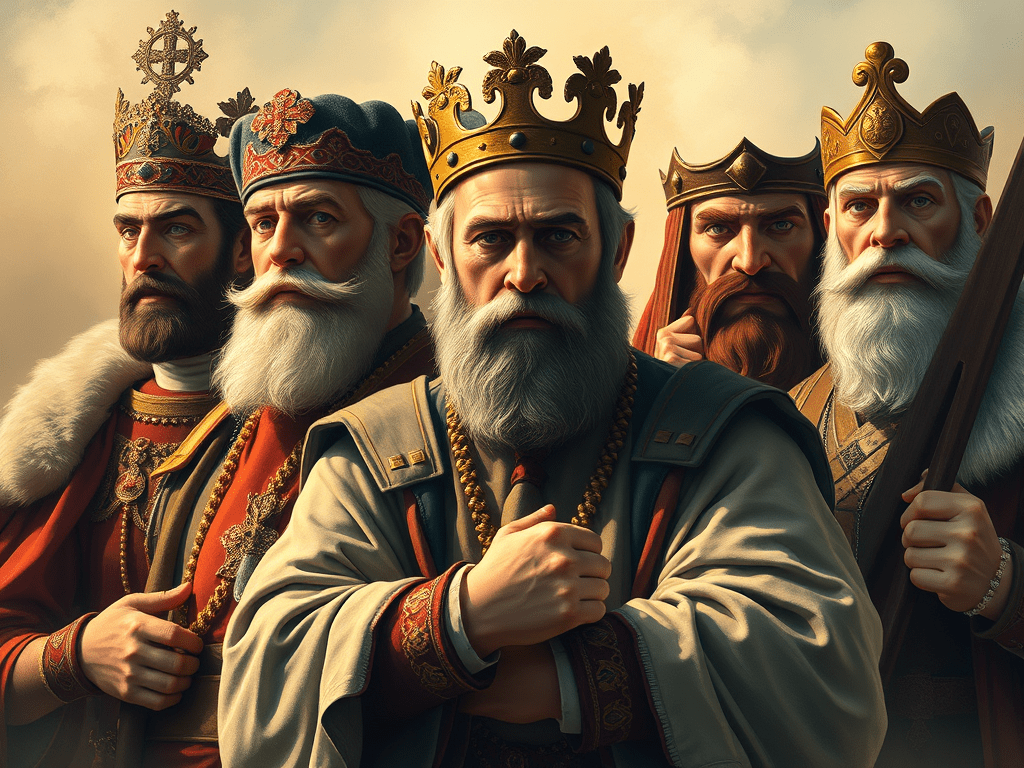
Part 2 : Reducing the 58 Rulers of England to 32.
Check out Who Was England’s Greatest Ruler? A Fun Podcast Vote to see why and how the History of England Podcast members decided to vote on who was the Greatest Ruler (well, Head of State really) of England.
In this post we will look at the first round of the competition with a short summary of all the rulers, and then see how each of them faired in the competition in Round 1.
I’ll list the rulers of England in the order they were voted for, along with the short summary about each one which was made available to the HoE members, along with the number of votes they scored in Round 1. At the end of the post you will find the Summary of Scores and then the draw from Round 2 onwards into the Final.
Round 1 – Pool A
Edward VII (1901 – 1910) – Saxe-Coburg-Gotha (51 votes)
From the Ladybird Book of King and Queens (1968) “Edward was sixty when his mother died and he became King. He had never been allowed by Victoria to have any part in affairs of state, and his main interests were sport and travel.” Also “Edward has been called the Peacemaker, and he did a great deal to bring about real friendship between England and France.” Not yet covered in the podcast obviously, and the Ladybird book decided to show a picture of Louis Bleriot rather than Edward … hey ho.
Henry III (1216 – 1272) – Plantagenet (43 votes)
From the Ladybird Book of King and Queens (1968) “When Henry came of age he proved to be a weak king. He was pious and vain, and the people hated and despised him. He allowed himself to be governed by the foreign relations of his wife, and finally the barons revolted.” Also “Parliament was summoned by a man named Simon de Montfort, and he not only summoned two knights from each shire, but also two citizens from each town.” Podcast episodes 62 to 76 cover Henry III’s reign including Simon De Montfort’s revolt, plus a whole heap of other stuff on the peasantry etc.
Canute (Cnut) (1016–1035) – Danish (166 votes)
From the Ladybird Book of King and Queens (1968) “Edmund was assassinated within a year, and Canute the Dane was chosen King of all England by a gathering of noblemen. Canute was King of both Norway and Denmark, but he liked best to live in England.” Also “For sixteen years England was peaceful, and the people grew wealthy.” Podcast episodes 16 – 17 covers Canute (Cnut) amongst other things.
Round 1 – Pool B
Athelstan (925 – 939) – Saxon (159 votes)
From the Ladybird Book of King and Queens (1968) “Fighting with the Danes continued during the reigns of Edward’s two sons, one of whom, Athelstan, won a great victory over them at a place called Brananburg.” Is that it??? He is the first recognised King of England, which must count for something a bit more than that methinks. Podcast episode 11 covers Athelstan.
William II (Rufus) (1087 – 1100) – Norman (53 votes)
From the Ladybird Book of King and Queens (1968) “William II, who was known as William Rufus because of his ruddy complexion, was a strong king. He kept the unruly barons in order and resisted their growing power” and “But he was harsh to the common people of England, and men were savagely punished for small offences: it is not surprising that he was mysteriously killed by an arrow whilst hunting in the New Forest.” Podcast episodes 26 and 27 cover Rufus and that arrow …
Charles I (1625 – 1649) – Stuart (19 votes)
From the Ladybird Book of King and Queens (1968) “Like his father, James I, King Charles believed in the Divine Right of Kings. He was not a stupid man, but he was obstinate and deceitful. He did not realise that the people of England were determined to rule the country by means of their freely elected Parliament. When they found that the King’s word was never to be trusted, a bitter struggle was certain.” Hmmm … “Freely elected Parliament” possibly a bit rose tinted glasses? Anyhow, in podcast episodes 343 through 411, Charles has been given (in my opinion) a very complete and very fair treatment by the HoE.
Round 1 – Pool C
Sweyn Forkbeard (1013 – 1014) – Danish (38 votes)
From the Ladybird Book of King and Queens (1968). What? He doesn’t even get a mention? Who could leave out a guy with the cognomen “Forkbeard”? He’s hidden in this sentence about Ethelred the Unready “During the years that he reigned, the Danes ravaged England from coast to coast.” Podcast episode 15 covers the King with the best name.
Charles II (1660 – 1685) – Stuart (32 votes)
From the Ladybird Book of King and Queens (1968) “When Cromwell died there was no-one to succeed him. The country was tired of being ruled by men who hated pleasure in any form.” and “He was the exact opposite to Cromwell and the Puritans. He was witty, amusing and popular. He was also one of the cleverest kings ever to occupy the English throne”. Not yet covered in the podcast but he had a great song on Horrible Histories, and whilst still a devotee of the Divine Right of Kings Charles II was perhaps the ultimate pragmatist?
Victoria (1837 – 1901) – Hanover (129 votes)
From the Ladybird Book of King and Queens (1968) “Queen Victoria, the niece of William IV, reigned through a period of tremendous changes in Britain and in the world. She was obstinate and not very clever, but she was sincere and devoted to her country.” And … “During her reign, England became the centre of the greatest Empire the world has ever known. By the time she died, Victoria ruled over one quarter of the globe.” Not yet covered in the podcast but the TV drama series with Gemma Coleman was really good I thought (especially Nigel Lindsey as Robert Peel), and I did like Judy Dench in Mrs Brown!
Round 1 – Pool D
Edward V (1483) – Plantagenet: York (10 votes)
From the Ladybird Book of King and Queens (1968). “He was the rightful heir to the throne as Edward V, but he was never crowned. Instead, he was imprisoned in the Tower of London by his uncle, Richard, Duke of Gloucester. He never left it. He and his brother were both mysteriously murdered.” Our first uncrowned monarch Edwards is a sad story and one of the great historical murder mysteries. Podcast episode 193 covers Edward.
Elizabeth I (1558 – 1603) – Tudor (150 votes)
From the Ladybird Book of King and Queens (1968) “When Mary died and her younger sister Elizabeth became Queen, the people felt safe again. So did Elizabeth. Mary had become insanely jealous of her, but Elizabeth, at twenty-five, was one of the cleverest women in the country, and although she was a Protestant, she managed to stay alive even though many others were executed.” First appeared I believe in episode 229 and stayed with us through to episode 321. What came across most for me was her sass and her intelligence. Personally, I can’t get past Miranda Richardson’s Queenie in Blackadder …
Edmund II (Ironside) (1016) – Saxon (51 votes)
From the Ladybird Book of King and Queens (1968), he only gets a one-liner: “He (Ethelred the Unready) was succeeded by Edmund, who was forced to make a treaty with the Danish King Canute, after being defeated at the battle of Assandune.” Not the best CV, but perhaps you can come up with something more positive about him? Covered in podcast episode 16.
George IV (1820 – 1830) – Hanover (12 votes)
From the Ladybird Book of King and Queens (1968) “George IV was even more unpopular than his father. When he drove through the streets, stones were thrown at his carriage, and he had to be protected by soldiers. He was selfish and vain, and evidence of his stupid extravagance may still be seen in the Pavilion which he built at Brighton.” On a more positive side his actions in Ireland were greeted with some approval and smoothed the path to the emancipation of the Catholics. Not yet covered in the podcast but two great TV portrayals: Hugh Laurie in “Blackadder III” and Mark Gatiss in the fabulous “Taboo” …
Round 1 – Pool E
John (1199 – 1216) – Plantagenet (16 votes)
From the Ladybird Book of King and Queens (1968). “John is remembered in our history as the king who was forced by the barons to affix his seal to Magna Charta, a copy of which may be seen in the Record Office in London. This did not give to the people any new rights but contained a list of all those granted since the days of Alfred and taken away by King John.” Podcast episodes 51 to 59 covers this most unpopular of kings. But was he as bad as everyone says?
Henry VIII (1509 – 1547) – Tudor (106 votes)
From the Ladybird Book of King and Queens (1968) “Henry VIII was the right kind of king needed by England at the beginning of the XVI century. He was strong and ruthless, but he was also clever and determined that England should be powerful and prosperous.” And also “The fact that he was married six times is what is usually remembered about him. This is only important because his second marriage was the reason for the establishment of the Church of England.” First appeared I believe in episode 207 and stayed with us through to episode 252. ‘Nuff said …
Edred (Eadred) (946 – 955) – Saxon (69 votes)
From the Ladybird Book of King and Queens (1968), he only gets a one-liner: “Edred was not a strong fighting man like Edmund. His reign is chiefly notable because he chose the cleverest man in England, the Abbot Dunstan, to be his adviser.”. Covered in podcast episode 12.
Henry VI (1422–1461, 1470–1471) – Plantagenet: Lancaster (24 votes)
From the Ladybird Book of King and Queens (1968) “Henry VI was only nine months old when he became king, and he grew up to be simple-minded, and sometimes quite mad. This was unfortunate for England: it was a time when a strong king was needed.” Not a fan then … But “Henry was pious and interested in education. It was ‘ he who founded the famous school of Eton in the year 1440 and, a year later, King’s College, Cambridge, already a university town since 1226.” First appeared I believe in episode 154 and stayed with us through to episode 171.
Round 1 – Pool F
Edward IV (1461-1470,1471-1483) – Plantagenet: York (133 votes)
From the Ladybird Book of King and Queens (1968). “Edward, Duke of York, like Henry VI a descendant of Edward III, claimed the throne after the defeat of Henry’s army. He captured London and was crowned as Edward IV whilst Henry VI was still the legal king.” And also: “Edward IV was a handsome young man, brave, popular, and a good ruler. He encouraged trade and was the patron of Caxton, the first English printer.” And he married for love, bless. Possibly not a great move considering his job and what subsequently happened. Podcast episodes 169 to 186 covers Edward’s adventures.
William IV (1830 – 1837) – Hanover (50 votes)
From the Ladybird Book of King and Queens (1968) “William IV, younger brother of George IV, had been a sailor, and his chief interest was the Navy. He was a timid, cautious man who often made _ himself ridiculous by very foolish speeches. As a king he was a failure.” And also during his reign “It is very regrettable that many Englishmen should have grown rich by this means (slavery). However, in the year 1833, slavery was finally abolished by law.” William was not a fan of abolition, but then many at the time were not. He was physically brave having served in the Royal Navy, though never under fire. Not yet appeared in the podcast.
Stephen (1135 – 1154) – Bloise (31 votes)
From the Ladybird Book of King and Queens (1968): “Stephen was a nephew of Henry I and was elected King because Henry’s only son had been drowned at sea. Stephen was good-natured and friendly, and the people liked him, but he was an unfortunate king because he was unable to keep the barons in order.” Had a massive bust-up with Matilda and “ruled” in the loosest sense of the word during The Anarchy. Covered in podcast episodes 32 to 34.
Edward VIII (1936) – Windsor ( 3 votes)
From the Ladybird Book of King and Queens (1968) “When King George V died, his eldest son became King as Edward VIII. He was never crowned. When he announced his intention to marry a divorced woman, Parliament told him that if he did so, he would have to abdicate — that is, cease to be King.” Dereliction of duty, or should love conquer all? Not yet appeared in the podcast, but played excellently by Guy Pearce in The King’s Speech I thought.
Round 1 – Pool G
Richard III (1483–1485) – Plantagenet:York (35 votes)
From the Ladybird Book of King and Queens (1968). “Richard had himself crowned as Richard III, and it is probable that the boy king (Edward V) was murdered by his orders. This has never been proved. Fortunately, Richard’s reign was short. It lasted two years, ending when he was killed at the battle of Bosworth by the followers of another claimant to the throne, Henry Tudor.” And “With the death of Richard III, what is called the mediaeval period of our history came to an end.” . Richard I think appeared around episode 168 with the Yorkists returning to England, but it might have been earlier, as he’s in that background throughout the wars. He gets killed in the car park in episode 192.
Edmund I (939–946) – Saxon (46 votes)
From the Ladybird Book of King and Queens (1968, he gets a one-liner like several other Saxon kings, which doesn’t appear to have been a handicap for the Saxons doing really well in this competition … “The other (son of Edward the Elder), Edmund the Elder, won from the Danes the Five Boroughs of Leicester, Lincoln, Nottingham, Stamford, and Derby.”. He seems to have been quite key in helping the Scots get a united Scotland kicking the Vikings out of Strathclyde and York, so go Edmund. His reign is covered in episode 12.
Richard Cromwell (1658–1659)
From the Ladybird Book of King and Queens (1968). Wha? No entry? Ok, so Lord Protector II doesn’t feature in this illustrious publication, but he definitely was a thing. Not yet covered in the podcast, but grabbed this mini-summary from good ol’ Wikipedia. “Following his father’s death in 1658, Richard became Lord Protector, but he lacked authority. He tried to mediate between the army and civil society, and allowed a Parliament that contained many disaffected Presbyterians and Royalists to sit. Suspicions that civilian councillors were intent on supplanting the army peaked in an attempt to prosecute a major-general for actions against a Royalist. The army made a threatening demonstration of force against Richard, and may have had him in detention. He formally renounced power only nine months after succeeding.” Oh dear …
Elizabeth II (1952–2022)
From the Ladybird Book of King and Queens (1968) “George VI died at the age of 57, and his eldest daughter, Elizabeth, became the fourth English queen to reign in her own right. In England she reigns as Elizabeth II, but in Scotland, which never came under the rule of Elizabeth Tudor, she is known as Elizabeth I” Well I never … is that a good fact or what? Our longest serving monarch ever, lived across perhaps the most tumultuous of times and the era of fastest technological changes that human race has ever seen. How did she do? In a world where monarchy is seen as increasingly irrelevant and outdated, did she manage to stay relevant? She certainly became the most recognisable person in the world in her time and possibly still is. Your say, your vote!
Round 1 – Pool H
Richard I (1189–1199) – Plantagenet
From the Ladybird Book of King and Queens (1968), “Richard I, known as Richard the Lion Heart because of his personal courage, succeeded to the throne after having been in open rebellion against his father, Henry II.” And also … “Richard was a bad king for England. During his reign of ten years he spent only a few months in his kingdom, and visited it only to raise money for the Crusades, the name given to military expeditions the object of which was to capture the Holy Land from the Mohammedans.”. Bit harsh possibly, often forgotten he was ruler of a European Empire, not just King of England. Episodes 44 – 51 cover the life of The Lionheart.
Ethelred II (The Unready) (978–1013, 1014–1016) – Saxon
From the Ladybird Book of King and Queens (1968), just a one-liner for him “Ethelred the Unready, which means “‘the badly advised”’, was only ten when he became King. During the years that he reigned, the Danes ravaged England from coast to coast.” Instigating the St Brice’s Day massacre’s was probably not the greatest decision he could have made, especially when his adversary was Sweyn Forkbeard! Episode 14 covers Aethelred’s reign and the battles to keep the Vikings out.
Lady Jane Grey (1553) – Tudor
From the Ladybird Book of King and Queens (1968) … Nothing. No mention, I mean really? As David I think covered in the podcast, she was the legitimate Queen of England as specified in Edward’s will, so despite the fact that she never was crowned, she deserves her place in this competition as far as I am concerned. Maybe there are good people of this Parish who will step forward and support this Plato reading young girl, or maybe the good people will turn their backs in favour of the popular choice of the time Mary. Is it time for Lady Jane Grey to stage a bi of a comeback, or will she once more sink to being a mere afterthought … Episodes 264 through 265a cover the amazing story of Lady Jane Grey.
George VI (1936–1952)
From the Ladybird Book of King and Queens (1968), “When Edward VIII abdicated, George VI became King unexpectedly. Like his father, he had been trained as a naval officer and would have preferred to remain one. But he became a good and popular king.” And also …”George VI remained in London, even though Buckingham Palace was partly bombed, and he frequently visited the devastated streets and houses, encouraging and helping those made homeless.” The late Queen’s father, never had good health, but gained a good reputation during the war. Brilliantly played by Colin Firth in the outstanding The Kings Speech, who brought real humanity to the character. Not yet covered in the podcast and possibly never will be…
Round 1 – Pool I
James I (1603 – 1625) – Stuart
From the Ladybird Book of King and Queens (1968), “James was never a popular king. He was ungainly and slovenly in appearance, and untrustworthy and deceitful. He believed that a king could do no wrong, and his persecution of the Catholics resulted in many plots being formed against him.” However, it also notes “It was by order of James that the Authorised Edition of the Bible was made, and every copy today has printed in it a dedication to him. This is to his credit”. I’m currently listening to The History of Scotland and David is doing an in-depth narrative of James I and far from the slovenly, ungainly and untrustworthy king mentioned above, he comes across as a) actually a pretty decent guy b) a bloody good king, certainly of Scotland and c) no idiot. Podcast episodes 252 – 343 cover the life of James 1, and also check out history of Scotland episodes 50 – 54.
Henry I (1100 – 1135) – Norman
From the Ladybird Book of King and Queens (1968), “Henry was the younger brother of William Rufus. The rightful heir to the throne was his elder brother, Robert, but Robert was away on a crusade, and Henry had himself proclaimed King before he returned.” And “Henry ruled the country wisely and well. He set up law courts and made people respect them, he improved the coinage, and he pleased the common people, who were Anglo-Saxons, by marrying a direct descendant of Alfred the Great.” Bit of a sneaky character then is our Henry. Episodes 29 – 31 cover the life of Henry I.
Edgar (959 – 975) – Saxon
From the Ladybird Book of King and Queens (1968), another one-liner for a Saxon. “Edgar recalled the man (Dunstan) whose wise policy made England peaceful, and united it as one country. Edgar was recognised as the ‘Ruler and Lord of the whole Isle of Albion’, meaning England, by eight Welsh and Scottish kings.” Sometimes known as Edgar the Peaceable, knowledge of his reign is hampered by lack of written records. He seems to be responsible for the expansion of the monasteries and with associated with the Benedictine Reforms i.e kicking the secular clergy out of the monasteries and replacing them with monks. Episode 13 covers the life of Edgar.
Round 1 – Pool J
Matilda (1141-1148) – Norman
From the Ladybird Book of King and Queens (1968), although she doesn’t get a page to herself, she does get a mention on the page about Stephen “Henry had wished his daughter Matilda to reign after him, and many of the barons, who only wanted an excuse to make war on their neighbours, took up arms on her behalf.” Basically, she was the other half of the Anarchy, not necessarily a good thing to be associated with, she was never crown, but was Henry I’s preferred choice over Stephen, read into that what you will. Episodes 32 – 34 cover the life of Matilda.
Anne (1702–1714) – Stuart
From the Ladybird Book of King and Queens (1968), “Queen Anne was a good woman, popular with her subjects, but unfortunately she was not very clever. This meant, however, that Parliament became more important than ever, and since her reign its power has never been questioned.” Hmmm, seems a little harsh to say the least and almost certainly due to some literary assassination by The Duchess of Marlborough. One thing that is definitely coming across about Anne recently is she seemed to be a kindly person in many ways but plagued by ill health and had, wait for it …17 pregnancies, yes 17! And sadly, none of the little sproglets survived beyond a year or so… very sad. Not yet covered in the podcast.
Edward I (1272–1307) – Plantagenet
From the Ladybird Book of Kings and Queens (1968): “He strengthened the authority of Parliament and enforced the law. As a soldier he was justly famous. He became known as the Hammer of the Scots after the battle of Dunbar, and he put down rebellion in Wales. It was after this that he promised to give to the Welsh a prince born in Wales and who could speak no English. The legend tells us that he presented to them his baby son, born at Caernarvon, who was not old enough to speak at all.” Reign covered in podcast episodes 71 to 86. From the HoE website: “Hate him or loathe him, Edward can at least say that no-one could ignore him” …
Round 1 – Pool K
Mary I (1553–1558) – Tudor
From the Ladybird Book of King and Queens (1968), “Queen Mary reigned for five years. If she had reigned longer, it might have been disastrous for England. She hated her father, Henry VIII, for having divorced her mother, and she hated the Church of England, which Henry had established to make the divorce possible.” Also, “There had been religious persecution in England before, but under Queen Mary it grew very much worse. Many hundreds of those who refused to become Catholics were put to death or savagely tortured.” Not a big fan then … Not sure exactly when Mary enters the scene, sometime around episode 212 after Henry VIII’s marriage to Catherine and ends in episode 279.
George III (1760–1820) – Hanover
From the Ladybird Book of King and Queens (1968), “George III was the victim of an inherited disease from which his far-off ancestor James I had also suffered. This made life very difficult for him, and sometimes he seemed to become quite insane. Like Charles I, he wanted to make himself the absolute ruler of the country, but only succeeded in strengthening the power of Parliament.” So did something good without meaning to ? Also .. “With the help of his chief minister, Lord North, he lost the American colonies by trying to make them pay taxes without their consent. The last straw was when he put a tax on tea.” I have to admit, a tax on tea is never a good thing! Not yet covered in the podcast.
Edward (The Confessor) (1042–1066) – Saxon
From the Ladybird Book of King and Queens (1968), “A descendant of Alfred the Great was again on the throne of England. But Edward was simple and pious, ill-fitted to rule. Having been brought up in Normandy, he spoke the Norman language, and surrounded himself with Norman favourites.” Also … “In the heart of London is Westminster Abbey. It was Edward the Confessor who founded it, and it was consecrated in 1065.” So that is a positive. Episode 19 covers the life of Edward the Confessor.
Round 1 – Pool L
George I (1714 – 1727) – Hanover
From the Ladybird Book of Kings and Queens (1968) “George I was fifty-four years of age when he became King of England. He was a very stupid man, and as he never took the trouble to learn to speak English, he was unpopular with everybody. As a king he was completely unimportant.” Not a fan then. A 2001 book by R Hatton, suggest he worked hard, was a good diplomat, wasn’t nice to his wife but was not ‘stupid’. The picture in the Ladybird book is of newspapers being delivered, which apparently was more significant to write about than any other details about George. Not yet in the podcast, possibly mentioned in a constitution shedcast?
Edward (The Martyr) (975–978) – Saxon
From the Ladybird Book of King and Queens (1968) he gets barely a sentence … “Edward, the elder (son of Edgar), was murdered when he was sixteen,”. Not much to go on there, poor lad seems to have been pulled and pushed around by his nobles. Episode 13 (I think) covers the short life of Edward the Martyr.
Henry II (1154 – 1189) – Plantagenet
From the Ladybird Book of King and Queens (1968), “Henry II inherited a poor country, ruined by civil war and reduced to misery and suffering. Although only twenty-one, he was wise and energetic. He soon disarmed the barons and made people once more respect the law.” Good man! Hang on … “Henry’s chief adviser was Thomas a Becket, the son of the portreeve, or mayor, of London. Becket served the king well. Unfortunately, Henry had him appointed Archbishop of Canterbury, hoping thereby to rule the Church as well as the country. But Becket became the champion of the Church against the king. “‘Will none of the knaves eating my bread rid me of this turbulent priest!’ shouted Henry. Four of his followers took him at his word and murdered Becket in Canterbury Cathedral.” Oh dear, Bad man? Episodes 38 – 43 cover the life of Henry II. And what a life …
Edwy (Eadwig) (955 to 957) – Saxon
Eadwig became king in 955 aged about fifteen and was no more than twenty when he died in 959. He was King of all England from 955 to 957, and then just King of Wessex and Kent until his death in 959. His only mention in the Ladybird Book of Kings and Queens (1968) is “Edwy, the next King, quarrelled with Dunstan and banished him” The possible reasons why and the rest of his short reign is covered in the first half of podcast episode 13 “The Golden Age”.
Round 1 – Pool M
George V (1910–1936) – Windsor
From the Ladybird Book of Kings and Queens (1968) “George V had not expected to become King, and had been trained as a naval officer. When his elder brother died, he became heir to the throne and King in 1910. George V was a very conscientious man and a good and popular king.” And also … “He also helped to found the League of Nations, in an attempt to secure world peace.” That didn’t work out of course, but hey, well done for trying. Not yet in the podcast, possibly never will be.
Henry VII (1485–1509) – Plantagenet: Lancaster
From the Ladybird Book of King and Queens (1968), “The claim of King Henry VII to the throne was a weak one, though it was strengthened by his victory at Bosworth, on the battlefield of which he was immediately crowned.” Also … “Henry VII was a wise king. He realised that in the past the country had suffered because it was poor. Taxes had often been too high, and the money so gained had been wasted. He determined to put an end to expensive wars abroad, and to make taxation fair at home.” Hmmm, not sure that worked out so well … Henry appears in the middle of the wars of the roses episodes so around episode 177 through to 208 cover the life of Henry VII.
Edward III (1327–1377) – Plantagenet
From the Ladybird Book of King and Queens (1968), “Edward claimed to be the rightful King of France, which involved England in the Hundred Years War. The battle of Crecy was fought and won in 1346: the Scots were defeated at Nevilles Cross in the same year. It was at Crecy that the English long-bow was first used with terrible effect on the French knights in armour.” Also, rather amusingly “From now on English was used in all Courts of Law, and the first great English poet, Chaucer, wrote in a language which we can understand today.” Chaucer … understand today … hmmm Episodes 94 – 116 cover the life of Edward III.
James II (1685–1688) – Stuart
From the Ladybird Book of Kings and Queens (1968) “James II, the younger brother of Charles, was brave and intelligent, but he was a Catholic, and his two aims were to make England a Catholic country, and himself an absolute monarch. He failed in both.” Oh dear … “He was so unpopular with Parliament and the people that when the Protestant William of Orange landed at Torbay to claim the crown, many thousands of men, including a large part of the army, joined him. James fled in disguise, dropping the Great Seal of England into the Thames as he did so. He hoped, in vain, by this stupid action to make the government of England impossible.” I’m trying to find something positive, but it’s hard, very hard … Not yet in the podcast
Round 1 – Pool N
Edward II (1307–1327) – Plantagenet
From the Ladybird Book of Kings and Queens (1968) “Edward II was very different from his warlike father. He was idle and fond of pleasure, and soon the barons were doing very much as they pleased. Edward was wise enough to summon Parliament, and so won the people to his side for a time, but his reign was one of trouble and uncertainty.” But if you’re Scottish and independence is your thing “In Scotland, Edward II lost all that Edward I had won, and after the defeat of the English at Bannockburn, Scotland again became a separate and independent kingdom.” So maybe some support there from the Scottish members of the parish? Episodes 87 – 94 cover the life of Edward II.
George II (1727–1760) – Hanover
From the Ladybird Book of King and Queens (1968), “It was said of George II that his greatest pleasure was counting his money, piece by piece. He was Just and honest, but not very intelligent. This was to the benefit of the country, because during his reign the King had less and less influence in the Government.” Defeated Bonnie Prince Charlie of course, which you may see as a good thing or a bad thing. Not yet in the podcast.
Henry IV (1399–1413) – Plantagenet: Lancaster
From the Ladybird Book of King and Queens (1968), “His reign was a troubled one. One after another, rebellions broke out against him, and each was followed by savage executions. All the good that can be said of him is that he encouraged artists and men of letters.” He was the first King since William whose first language was English, so that is a positive right there, and he hosted a Byzantime Emperor Manuel II Palaiologos, so that was cool! Episodes 127 – 140 cover the life of Henry IV.
William I (The Conqueror) (1066–1087) – Norman
From the Ladybird Book of King and Queens (1968), “William, Duke of Normandy, was now the conqueror of England, and on Christmas Day 1066, he rode through a snowstorm to Westminster Abbey to be crowned. Today there remain many things for which William was responsible; among them the Tower of London, which he built, and the Domesday Book in which all the towns and villages and people of England were registered. During his reign he gave to the country a strong central government.” That’s putting it mildly … Is this where the glory days of English monarchy started, or do we still suffer under the Norman Yoke? Episodes 19 – 25 cover the life of Billy the Conq.
Round 1 – Pool O
Henry V (1413–1422) – Plantagenet: Lancaster
From the Ladybird Book of Kings and Queens (1968) “The name of Henry V will always be associated with Agincourt, the battle in which about six thousand English archers gained a great victory over more than thirty thousand French knights. This was the result of those long hours of practice with bows and arrows at the butts on the village greens of England.” Despite some revisionists dissing the man, he remains a powerful figure in history, and the myths about him are probably as powerful as any historical truth. “Cry Harry! For England and St George!”, Episodes 142 – 152 cover the life of Henry V.
William III and Mary II (1689–1702) – Stuart
From the Ladybird Book of King and Queens (1968), “William of Orange and his wife Mary were cousins, and both were descended from Charles I. They reigned together because each had a claim to the throne. When Mary died in 1694 William remained on the throne as William III.” Also .. “It was during the reign of William and Mary that the Bank of England was founded by a Scot named Paterson.” So that’s nice … Not yet in the podcast.
Hardecanute (1040–1042) – Danish
From the Ladybird Book of King and Queens (1968) this man doesn’t get good press … “Unfortunately, Canute was succeeded by two worthless sons, Harold and Hardicanute, who taxed and plundered their British subjects. During the next seven years the condition of the people of England became more and more wretched.” Oh dear … Episodes 17 and 18 cover the life of Hardecanute.
Harold II (Godwinson) (1066) – Saxon
From the Ladybird Book of King and Queens (1968), “In his short reign Harold had to meet two invasions, one, in the north, by King Hardrada of Norway, and another immediately afterwards, by Duke William of Normandy, two hundred and fifty miles to the south.” He did some mileage, and he nearly beat the Normans .. nearly. Episode 22 covers the life of Harold II.
Round 1 – Pool P
Harold I (Harefoot) (1035–1040) – Danish
From the Ladybird Book of Kings and Queens (1968), only mention is with Hardicanute “Unfortunately, Canute was succeeded by two worthless sons, Harold and Hardicanute, who taxed and plundered their British subjects. During the next seven years the condition of the people of England became more and more wretched.” Oh dear (again) … Episodes 17 and 18 cover the life of Harold I.
Richard II (1377–1399) – Plantagenet
From the Ladybird Book of King and Queens (1968), “Richard II was only ten years old when he came to the throne, and the country was under the control of his uncle, John of Gaunt.” And proved himself brave in the peasant’s revolt : “The young King rode out to parley with them. Suddenly there was a scuffle, and their leader, Wat Tyler, was killed. The King immediately rode up to the shouting, furious mob and cried, “‘Your leader is killed — I will be your leader!” The situation was saved by the courage of a boy of fifteen.” But it didn’t end well between him and Henry Bolingbrooke. Episodes 118 – 130 cover the life of Edward II.
Oliver Cromwell (1653–1658) – Lord Protector
From the Ladybird Book of King and Queens (1968), “England became a Commonwealth, and the man who had proved himself an able general in the Civil War became its ruler. He was a gentleman-farmer from Huntingdon, Oliver Cromwell, and his title was Lord Protector.” And also “Cromwell was stern but tolerant. He ruled England well and made her army and navy the best in the world. But, like King Charles, he had trouble with Parliament.” Will be interesting to see how the parish react to King Oliver … He first appears in and around episode 377and is still with us!
Edward VI (1547–1553) – Tudor
From the Ladybird Book of King and Queens (1968), “Although only fifteen when he died, Edward had already shown signs that he might have been a good ruler.” Yes, one of history’s great what ifs? What is Edward had lived? He showed promise and intelligence, so who knows how things may have panned out. Maybe nothing would have changed, because “The event most connected with Edward VI’s short reign was the issue of the Church of England Prayer Book in English. At the same time the taking over of the lands and treasures of the monasteries continued. This had been started by Henry VIII, and many people became very rich on the land which they were given by the King.” Episodes 262 – 264 cover the short life of Edward VI.
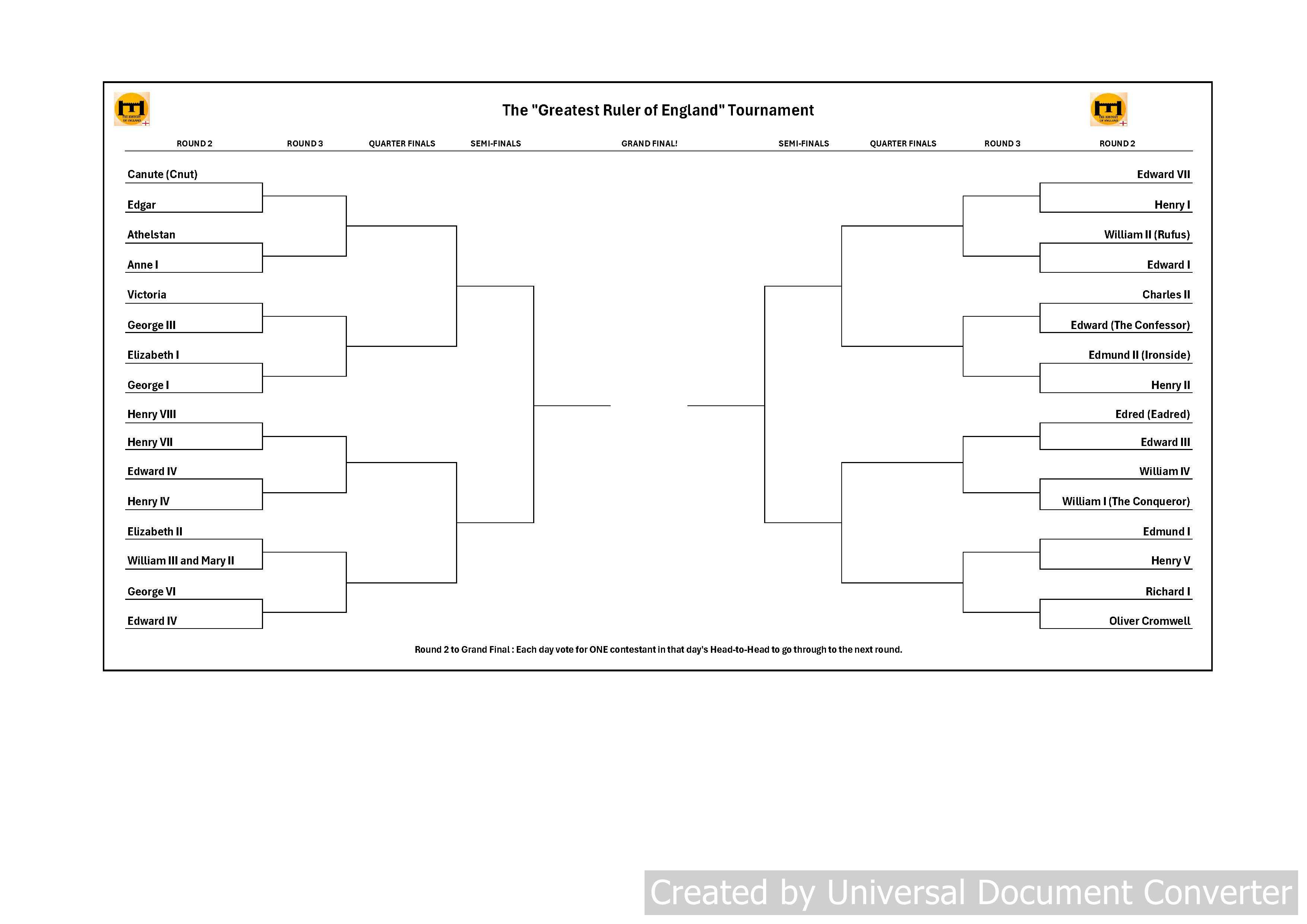
So those were our contestents in the contest and the members of the History of England podcast all cast their votes day-in and day-out for 16 days to choose the 32 contestents to go through to the second sound to fight it head-to-head. So first up here is the draw for the second round.
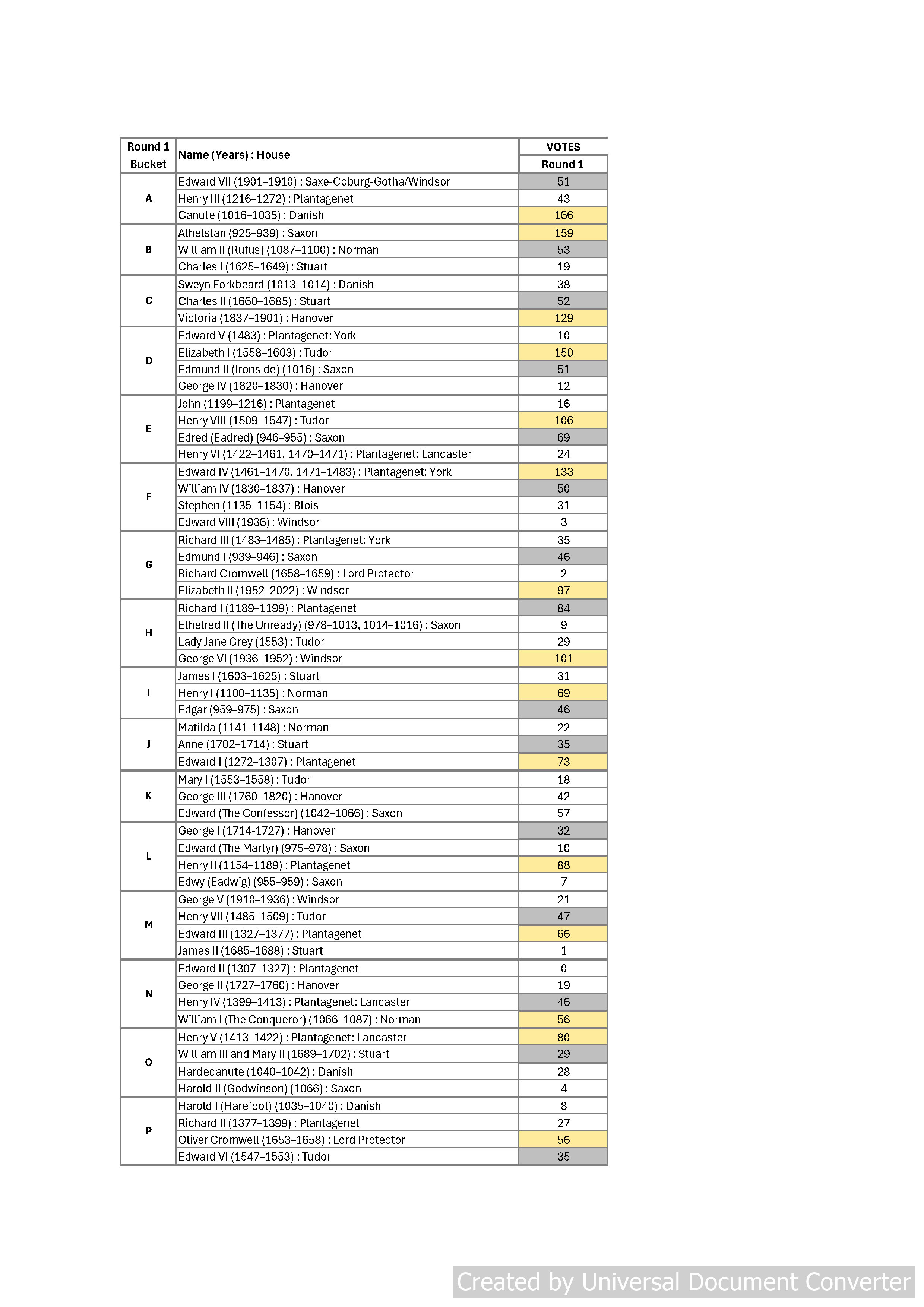
And here were the scores on the doors after Round 1. Those highlighted in Gold represent the winners of that group, the ones in silver came second and those un-highlighted did not make the cut for round 2.
Next time, we will see who was voted the Greatest Ruler of England in the ultimate contest!
Cheers


 Dave Mc's Blog
Leave a comment